



 1 / 2
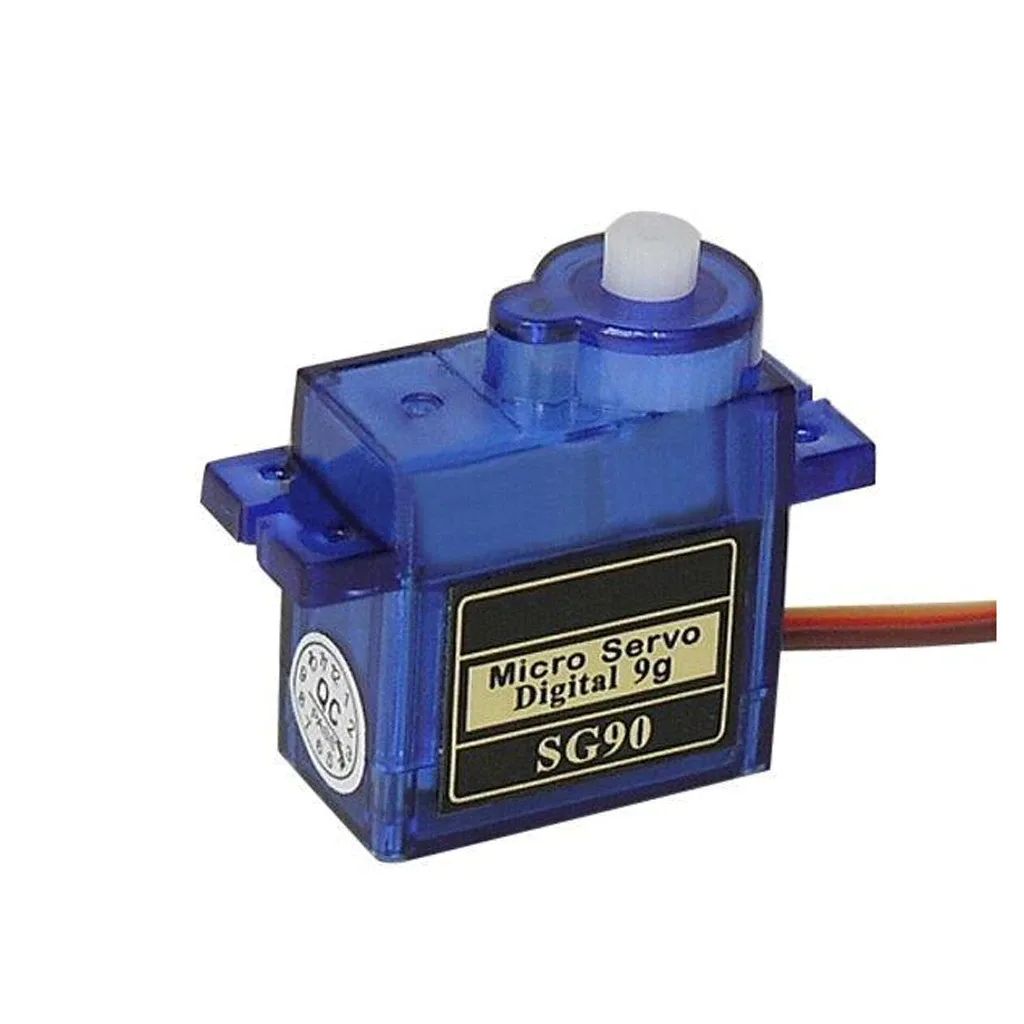
9G SG90 micro servo motor
SKU: HH-ROB-052
excl. VAT
Minimum order from the category "חלקי אלקטרוניקה": 3,000 ₪ before VAT across all the category's products together, or at least 300 ₪ of each product. Either one is enough.
In stock9G SG90 micro servo motor for remote-controlled (RC) robots, helicopters, airplanes, vehicles and boats. Weight 9 g, stall torque 1.8 kg·cm at 4.8V, speed 0.1 second per 60 degrees.
The delivery charge is calculated by the size of the parcel and is shown at checkout before payment; collection is free of charge.
Packaging and delivery specification
Package dimensions (L×W×H)
4×3×2 cm
Weight
0.02 kg
Dimensions and weight are estimates for delivery planning. The exact specification is the one in the document you receive — a price quote or an invoice.
Full description
9G SG90 micro servo motor for use in remote-controlled (RC) robots, helicopters, airplanes, vehicles and boats.
## Specifications
- Model: SG90
- Weight: 9 g
- Dimensions: about 23 × 12.2 × 29 mm
- Stall torque: 1.8 kg·cm (at 4.8V)
- Gears: nylon
- Speed: 0.1 second per 60 degrees (at 4.8V)
- Operating voltage: 4.8–6V
- Temperature range: 0°C to 55°C
- Power supply: via an external adapter
- Servo wire length: 25 cm
- Plug: JR (fits JR and Futaba)
- High quality and a high performance-to-cost ratio
In the package: one SG90 servo
The specifications suit the common TowerPro SG90; actual values may vary between manufacturers.
A servo motor is a direct-current (DC) motor with an internal gear transmission and electronic control of the motor's position.
What distinguishes servo motors is that they do not rotate freely like DC motors, but move according to an angle — usually between 0 and 180 degrees.
Servo motors work in a closed loop, meaning they control the motor's position and can correct deviations from the desired position.
Servo motors are used in a great many types of robots, including robotic arms, remote-controlled cars, vehicle robots, and airplanes and helicopters (to control the angle of the wing / rotor). There are many reasons servo motors are so common in robotics applications, among them the ease of controlling servo motors, the low energy requirements (efficiency),
the high force, the voltage level, and the low size and weight.
Operating principle of a servo motor
The motor is connected to a microcontroller that operates it and causes the motor to reach a desired angle. The software command that the controller runs is translated into a PWM voltage pulse that is passed to the control unit located inside the motor. This value is the desired value in the control loop.
The actual value of the motor is measured using a potentiometer connected to the motor's drive shaft (the shaft that comes out of the top of the motor and to which the mechanism to be driven is attached). Rotation of the potentiometer changes the measured resistance and, accordingly, the voltage drop measured across it. This voltage is the actual value that arrives as feedback to the closed control loop. As long as there is a difference (error) between the actual voltage and the desired voltage, the DC motor inside the servo continues to move in the appropriate direction. The rotation of the DC motor takes place together with the rotation of the gears — which serve as a reduction transmission (slowing the rotation speed and increasing the torque). The gears drive the output shaft and the potentiometer. Once the voltage difference is smaller than a threshold value, the motor's control unit disconnects the voltage source to the DC motor and it stops moving. The motor stops exactly at the angle required in the controller's program.
If the program instructs the motor to move to an angle beyond 180 degrees, the motor will begin to shake because it will try to close the error between the desired and actual values and will not succeed. In addition, there is a mechanical stop on the output shaft that prevents the motor from passing the 180-degree rotation angle
Choosing a servo motor
When choosing a servo motor suitable for a task, several factors must be considered. The first factor is how much torque is required to perform the task. Torque is calculated by multiplying the force that must be applied by the distance from the line of action of the force to the motor's axis of rotation. In the motor's manufacturer data sheet you can find the torque value (Torque)
The second factor is the motor's speed — how large an angle the motor covers in one second. This factor is important so that the system can respond quickly to changes in the system's operating environment. A fast motor can be slowed down in the software in various ways, but a slow motor cannot be sped up in software.
The following factors are of similar importance and should be taken into account in the design: the physical size of the motor, which must be considered when planning the motor's position and how it is attached to the system's chassis. The voltages and currents required for efficient operation of the motor determine the size of the external voltage source and additional control components to ensure the supply of voltage/current as required.
How to connect a servo motor
The motor has three wires
A black or brown wire, which is ground (-)
A red wire, which is the voltage (+)
A yellow, orange, or white wire, which is the signal wire for controlling the motor, connected to a digital PWM pin
Programming the controller to control a servo motor
The Arduino development environment recognizes a certain range of components, and they can be operated with the basic set of functions. A servo motor belongs to a large group of components that require special functions to operate. There are libraries of functions that contain special tools for specific components. The servo motor has such a library, installed in the Arduino development environment, called Servo.h. In such a library file there are definitions of all the special functions written for operating a servo motor. To use the library's contents, we must write the following line at the top of the program, which tells the controller to include in the program we are writing all the definitions of the new functions for the servo motor:
#include <Servo.h>
Inside the library there is a definition of a data structure (class) that provides access to all the special functions. The name of the data structure is Servo, and it is used the way a new variable is defined: the variable type and the variable name. We will choose a variable name that represents the role of the motor: for example, the motor on the right side of a robotic arm will be called rightServo, and then the variable definition line will be:
Servo rightServo;
Once we have created the variable, all the functions are available by writing the variable name, a dot, and the function name.
The first function to operate is called attach. This function is equivalent in meaning to the pinMode function that we met with other components, and it tells the controller that a servo motor is connected to the pin whose number is written in the parentheses
rightServo.attach(9);
Without a call to this function the motor will not work at all.
Now the motor can be operated by writing desired angle values using the write command. The command takes one angle parameter in the parentheses, whose value is between 0-180 degrees. There are motors that can reach more than 180 degrees, and then a larger angle value can be written
rightServo.write(47);
Several write operations can be performed in sequence to create a certain movement, but a delay must be placed between every two commands, because the motor's mechanical movement is slower than the Arduino controller's execution rate, and to avoid a situation in which many movement commands were sent to the motor but it cannot keep up, the timing must be planned accordingly.
Example programs
In the Arduino development environment you can find two example programs in the menu File->Examples->SERVO. One example is called sweep, which makes the servo motor move cyclically from 0 degrees to 180 and back.
The second example is called knob, and it combines a servo motor and a potentiometer. The program reads a value from the potentiometer, maps it to the range 0-180, and moves the motor to an angle accordingly.
Frequently asked questions
The motor is suitable for students and learners at a variety of education stages, from elementary school, through middle school and high school, to post-secondary frameworks and adults.
The package includes one SG90 digital servo motor.
The motor is connected to a microcontroller such as Arduino and is controlled through software commands and the dedicated Servo.h function library, which translate commands into PWM voltage pulses.
The motor has three wires: a black or brown ground wire marked with a minus, a red power wire marked with a plus, and a yellow, orange, or white wire that serves as the signal wire and connects to a digital PWM pin.
The motor moves according to an angle, usually between 0 and 180 degrees, with a mechanical stop on the output shaft that prevents it from going past that angle.