



 1 / 2
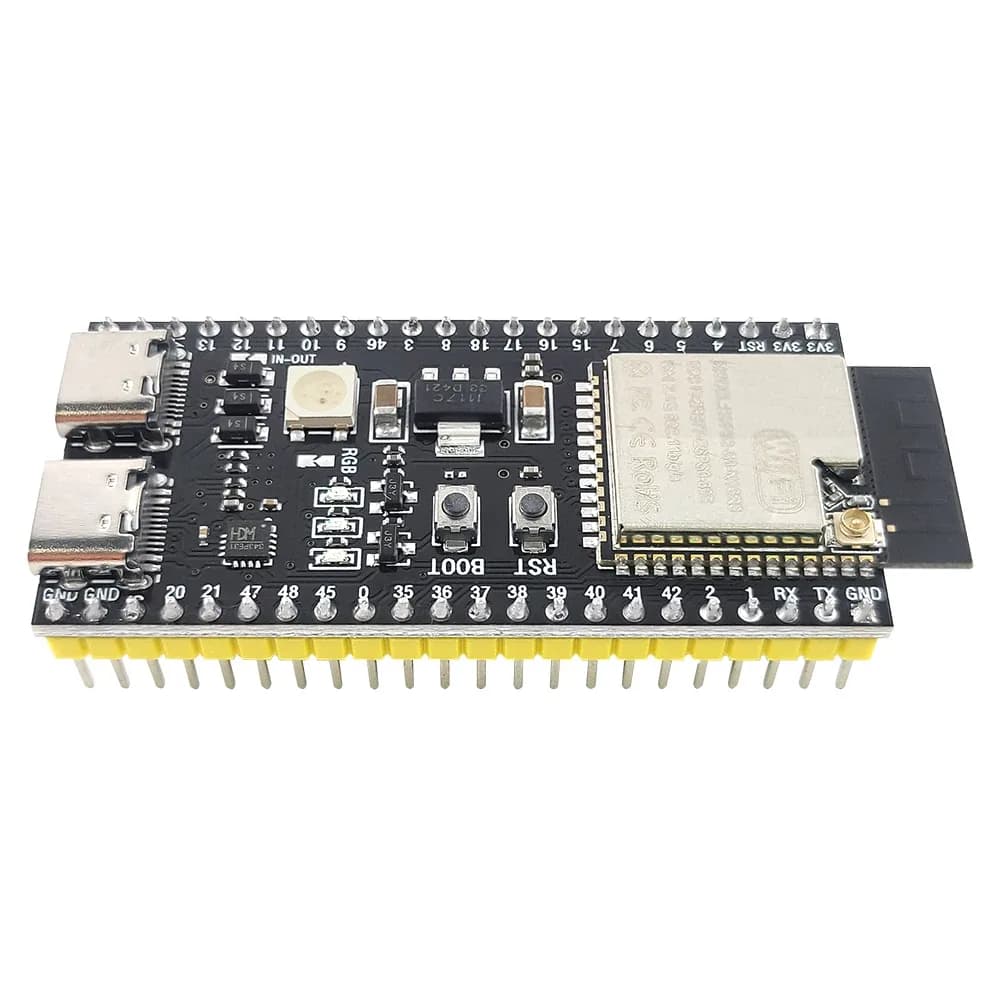
ESP32-S3 N16R8 development board with WiFi and Bluetooth, soldered pins (two Type-C ports)
SKU: HH-ROB-234
excl. VAT
Minimum order from the category "חלקי אלקטרוניקה": 3,000 ₪ before VAT across all the category's products together, or at least 300 ₪ of each product. Either one is enough.
Delivery within 15-20 daysA powerful ESP32-S3 board with 16MB of flash memory and 8MB of PSRAM, with built-in WiFi and Bluetooth. The pins are already soldered — it plugs straight into a breadboard. Suitable for projects in artificial intelligence, cameras, audio, and the Internet of Things.
The delivery charge is calculated by the size of the parcel and is shown at checkout before payment; collection is free of charge.
Packaging and delivery specification
Package dimensions (L×W×H)
10×7×3 cm
Weight
0.03 kg
Dimensions and weight are estimates for delivery planning. The exact specification is the one in the document you receive — a price quote or an invoice.
Full description
An ESP32-S3 development board, model DevKitC-1, with the ESP32-S3-WROOM-1 N16R8 module.
- Dual-core processor up to 240MHz with instructions for accelerating artificial intelligence
- 16MB of flash memory and 8MB of PSRAM
- WiFi 2.4GHz and Bluetooth 5 (LE)
- Two Type-C sockets: one for serial communication and one for the chip's own USB
- 44 pins, an RGB indicator LED, BOOT and RST buttons
- Works at 3.3V: the pins do not accept 5V directly
- The pins are already soldered — it plugs straight into a breadboard
In the Arduino IDE, add the ESP32 boards package once and select ESP32S3 Dev Module; it can also be programmed in Python (MicroPython).
Frequently asked questions
No. The pins are already soldered to the board, and it can go straight into a breadboard.
The ESP32-S3 has instructions that accelerate artificial intelligence, 16MB of flash memory and 8MB of PSRAM, so it suits heavier projects such as camera, sound and recognition.
Arduino IDE, after adding the ESP32 boards package once and selecting ESP32S3 Dev Module. It can also be programmed in Python (MicroPython).
One is used for regular serial communication, and the other connects directly to the chip's own USB. Usually it is enough to connect one of them.
The board runs at 3.3V, and its pins do not accept 5V directly. A component that outputs 5V is connected through a voltage divider or a level shifter.
Yes. It has built-in WiFi and Bluetooth, with no need for an additional module.